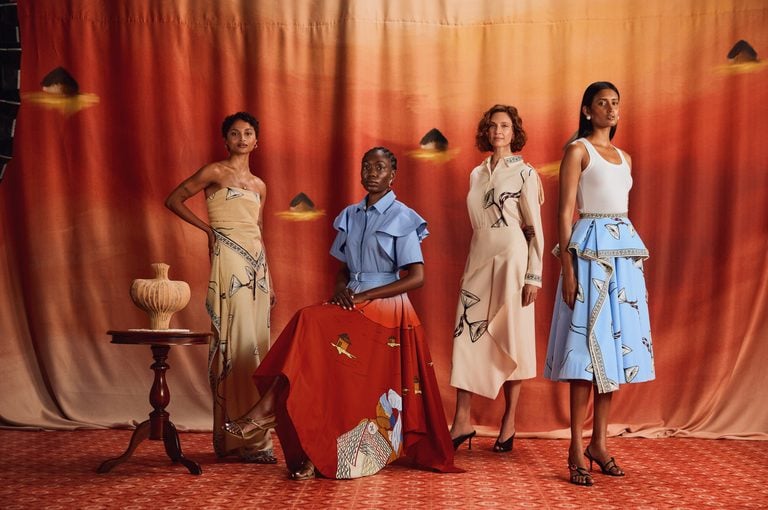

Every morning, in the quiet town of Alicedale in the Eastern Cape, a group of women unlock the doors of a modest textile factory and begin a process that cannot be hurried. There are no shortcuts here. Colours are measured with painstaking precision. Looms are prepared with care. Mohair is dyed, woven and finished by hand, using skills refined over decades. A single blanket can take more than a week to complete, its journey shaped by experience, patience and craftsmanship that simply cannot be replicated by a machine.
By the time a Barnard Mohair blanket is draped across a sofa or a shawl is wrapped around someone’s shoulders, it carries far more than warmth. It carries the hands, hearts and heritage of the women who made it.
In a fast fashion, mass production world, these women are quietly proving that some things are still worth taking time over.
For Louise Cameron, who returned to South Africa in 2022 to revive the nearly 60-year-old family business founded by her parents, they are the true custodians of Barnard Mohair’s legacy.
“I could write chapters about my staff,” she says with a smile. “They are the heartbeat of our operation.”
It is a statement that becomes easier to understand with every story she tells.

Delorus joined the business when she was just 23 years old. This year she turns 68. For almost 45 years she has watched the company evolve through changing fashions, economic uncertainty and new generations.
Margaret began working at Barnard Mohair at the age of 25 and is now approaching her 67th birthday. Over the decades she has mastered both traditional hand looms and modern electronically driven weaving equipment, adapting her skills while never compromising on quality.
Leona started working alongside Louise’s mother more than 30 years ago and today manages the dye house, overseeing one of the most technically demanding stages of production. Every shade must be measured with extraordinary precision, right down to fractions of a gram, because even the smallest variation can change the finished product.
Then there is Louwena, whose connection to Barnard Mohair stretches across generations. After her mother’s passing, she joined the business nearly two decades ago. Today, her own daughter is learning the craft as an intern, ensuring another generation of skills will continue.
Charlotte has spent more than 20 years designing and creating jackets while overseeing quality control, carefully inspecting every item before it leaves the factory.

Together, these women represent well over a century of combined experience. More importantly, they represent a commitment to craftsmanship that cannot be taught overnight.
“Textiles are a skilled trade,” says Louise. “When you work with mohair, even more so. The dyeing process alone takes years to perfect, and the knowledge that has been passed down through the years is not easy to replace. These ladies are incredibly valuable to me.”
Each member of the team comes from Alicedale. Many support extended families, meaning every job has an impact far beyond the factory floor. Behind every handcrafted blanket or shawl is a story of livelihoods sustained, knowledge preserved and a rural community strengthened through meaningful work.
For Louise, continuing the business is deeply personal.
After spending six years in London working for a family-owned manufacturer of luxury woven flooring, she gained invaluable experience in heritage brands, quality craftsmanship and long-term thinking. But something kept drawing her home.

“My journey back was one that God laid strongly on my heart,” she reflects. “My dad wasn’t well, and I realised help was needed.”
She returned to South Africa at a time when the business faced enormous challenges. Following the temporary closure of the factory during the Covid-19 pandemic, break-ins had left significant damage, with electrical wiring stripped from the building and machinery requiring extensive repairs before production could begin again.
Slowly, patiently and with determination, Barnard Mohair found its rhythm once more. Just months after restarting the business in 2023, Louise’s father passed away. It would have been easy to let the story end there. Instead, together with her sister Katrina Nel, who now leads the family’s mohair carpet business under the Sunday Child brand, Louise chose to continue building on the foundations their parents had laid decades earlier.
“It’s such an honour to continue a business that has been going for nearly 60 years,” she says. “It’s a legacy built on quality, durability and timeless design.”
Sometimes, that legacy reveals itself in unexpected ways.
“I still have people phoning me and telling me about their mohair curtains that were woven 40 years ago and are still hanging in their bedroom.”
In a time where so many products are designed to be replaced, there is something quietly remarkable about creating pieces intended to last a lifetime. That philosophy was brought into sharp focus recently when Barnard Mohair supplied 800 handcrafted throws for Coricraft stores across South Africa. Louise remembers returning from her honeymoon when her husband pointed towards one of the stores, where banners telling Barnard Mohair’s story hung proudly from the ceiling.
“We all helped tie bows around every blanket with our logo and swing tag,” she recalls. “Seeing them displayed in the flagship stores was such a proud moment.”
Yet for all the milestones, Louise believes the greatest achievement isn’t measured by retail partnerships or sales. It is seeing the legacy her parents began continue through the people they invested in.
“My mom always says my dad would be so proud of what we have accomplished,” she says. “I think he would be proud that we’re still creating beautiful products and continuing what they worked so hard to build all those years ago.”
This Women’s Month, while many celebrate women in leadership, Barnard Mohair offers a quieter reminder that leadership is not always found in boardrooms.
Sometimes it is found at a loom. Sometimes it is found in hands that have perfected a craft over four decades. Sometimes it is found in women who arrive every morning, not seeking recognition, but simply committed to creating something beautiful that will outlast them. And perhaps that is the greatest legacy of all.
Every thread tells a South African story. But it is the women behind every thread who ensure that story continues to be woven for generations to come.
For more information, visit https://barnardmohair.com/